The 5 Biggest Google Ads Announcements from Google Marketing Live 2026
Google Marketing Live 2026 delivered a huge wave of updates for advertisers, agencies and businesses running Google Ads campaigns. As always, some announcements were minor tweaks, while others hinted at major shifts in how campaigns will operate moving forward.
This year, the biggest themes were clear:
- More automation
- More AI integration
- Less manual control
- Increased focus on scaling spend and conversion volume
While some updates could genuinely improve campaign performance, others raise serious questions about transparency, efficiency and advertiser control.
In this article, we break down the five most important Google Ads updates announced at Google Marketing Live 2026 and explain what they actually mean for advertisers.
1. Performance Max Gets More Improvements and Channel-Level Reporting
Google announced that it has made roughly 90 improvements to Performance Max campaigns, claiming these updates have resulted in a 10% increase in conversions.
However, as always with Google’s performance claims, there is an important detail missing:
What happened to the cost per conversion?
More conversions do not automatically mean better performance. In many cases, increased conversion volume comes at the expense of efficiency and profitability.
The Most Important Performance Max Update
The standout announcement was the introduction of channel-level reporting for Performance Max campaigns.
Advertisers will now be able to see performance broken down across:
- Search
- Display
- YouTube
- Gmail
- Discover
- Other Google inventory
This is a significant step forward because one of the biggest criticisms of Performance Max has always been the lack of visibility into where budget is actually being spent.
The Catch: Limited Control
Although advertisers may finally gain visibility, there is still uncertainty around whether Google will allow users to opt out of underperforming channels.
That means advertisers could end up with:
- More reporting
- Better visibility
- But still very limited control
Should You Use Performance Max?
The answer depends entirely on your business model.
Performance Max Works Best For:
- E-commerce businesses
- Large product catalogues
- Brands looking for scale
- Businesses comfortable with automation
Performance Max Is Less Ideal For:
- Lead generation campaigns
- Businesses needing strict control over search intent
- Smaller advertisers with tight margins
For lead generation, search campaigns should still be the foundation. Performance Max can then be layered on later to capture incremental demand once search performance plateaus.
2. Smart Bidding Exploration Introduces Flexible ROAS Targets
Another major update is Smart Bidding Exploration, which introduces flexible ROAS targets.
Traditionally, advertisers set a strict Return on Ad Spend (ROAS) target, and Google attempts to maintain that exact efficiency level.
Now, Google is allowing advertisers to loosen that target range.
How Flexible ROAS Works
For example:
- Your standard target ROAS might be 500%
- You can now allow Google to bid outside that target range
- Google may pursue conversions below your desired efficiency if it predicts more sales volume
In practice, this means:
- More aggressive bidding
- Broader reach
- Potentially more conversions
- But likely lower efficiency
The Bigger Trend Behind This Update
This update reflects a broader shift happening across Google Ads:
Google increasingly prioritises conversion volume over efficiency.
That means many of Google’s AI-driven recommendations aim to encourage advertisers to:
- Spend more
- Reach more users
- Expand targeting
- Relax efficiency goals
While this may generate more sales, it does not always produce more profit.
What Advertisers Should Do
Before enabling flexible ROAS bidding, businesses need to ask:
- Can we afford higher acquisition costs?
- Will additional sales remain profitable?
- Does scaling volume actually improve business performance?
For some businesses, especially those with healthy margins, the answer may be yes.
For others, maintaining efficiency will remain the priority.
3. Ads Are Coming to AI Overviews
Perhaps the most controversial announcement was Google’s decision to place ads inside AI Overviews in search results.
This was inevitable.
Google has invested billions into AI search experiences and now needs to monetise them.
What Are AI Overviews?
AI Overviews are the AI-generated summaries shown at the top of certain Google search results.
Instead of showing only traditional search listings, Google now generates AI responses that summarise information from across the web.
Ads will now begin appearing inside these AI-generated experiences.
Why This Raises Concerns
The biggest issue is search intent.
Traditional Google Ads campaigns are built around high-intent commercial keywords, such as:
- “Plumber in London”
- “Emergency electrician near me”
- “Buy running shoes online”
AI Overview searches are often much broader and more informational.
For example:
- “Why is there a wet patch on my ceiling?”
- “How do I fix water damage?”
- “What causes mould in a house?”
These are discovery-based searches rather than clear buying-intent queries.
Key Questions Still Unanswered
Google has not yet explained several critical details:
1. How Will Ads Be Matched?
Will advertisers lose control over commercial targeting?
Could search campaigns start appearing for loosely related informational searches?
2. Will Advertisers Get Reporting Transparency?
This is arguably the biggest concern.
Advertisers want to know:
- How much spend went to AI Overviews
- Which search terms triggered ads
- What performance metrics look like
- Whether AI placements are profitable
Given Google’s increasing restrictions around search term visibility, many advertisers are concerned that AI Overview reporting may remain opaque.
This could become one of the largest transparency debates in Google Ads over the next few years.
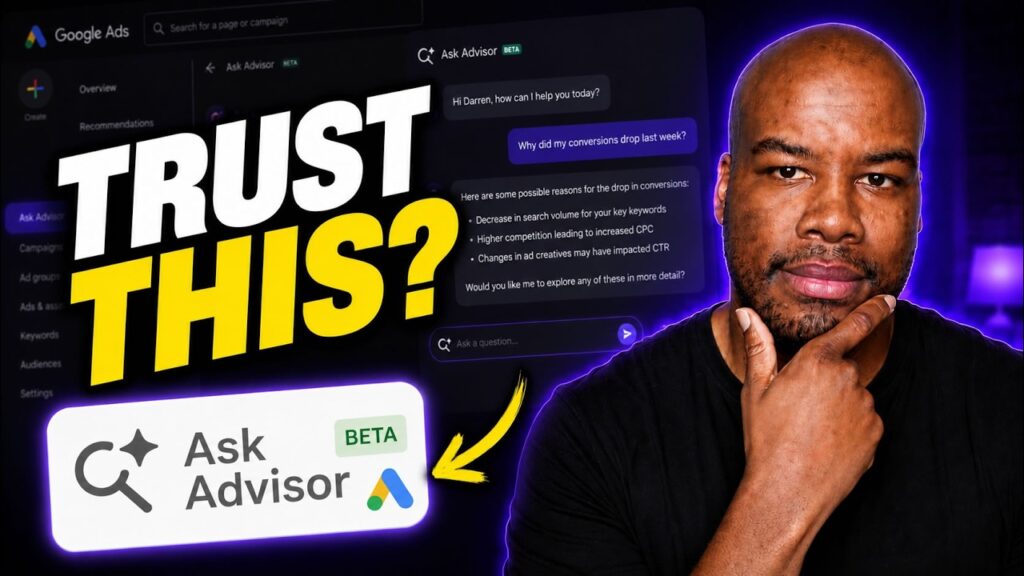
4. Google Ads AI Agents Are Coming
Google also unveiled its new AI agent for Google Ads.
This is effectively an AI-powered assistant capable of performing tasks autonomously within advertiser accounts.
What Can the AI Agent Do?
Google demonstrated an example where the AI agent:
- Detected missing conversion tracking
- Identified a missing Google tag
- Logged into a Wix website
- Installed tracking automatically
- Confirmed successful setup
For small businesses, this could genuinely solve a major problem.
Many advertisers struggle with:
- Conversion tracking
- Tag setup
- Attribution configuration
- Technical implementation
If AI agents can reliably handle these tasks, they could significantly improve campaign accuracy.
Where Things Become Risky
The challenge comes when AI agents move beyond technical setup and begin making strategic optimisation decisions.
Campaign optimisation involves far more than platform data alone.
Human decision-making considers:
- Business goals
- Seasonality
- Profit margins
- Inventory levels
- Product priorities
- Sales trends
- Market conditions
An AI agent operating solely inside Google Ads may not fully understand those external business realities.
The Bigger Concern: Bias Towards Google Revenue
Many advertisers are understandably concerned that Google’s AI agent may behave similarly to Google Ads representatives by consistently recommending:
- More automation
- Broader targeting
- Increased spend
- Additional campaign types
Even when those recommendations may not benefit the advertiser.
The AI agent could become extremely useful for technical tasks while simultaneously encouraging advertisers toward higher-spend automation strategies.
Advertisers should approach this carefully and avoid blindly accepting AI-generated recommendations.
5. AI Max for Search Could Fundamentally Change Search Campaigns
The final — and arguably most important — announcement was AI Max for Search.
This feature represents a major shift in how Google sees keyword targeting.
What Is AI Max for Search?
AI Max is a one-click setting that expands search campaigns beyond traditional keyword matching.
Instead of relying mainly on your selected keywords, Google uses AI to:
- Find additional related queries
- Expand targeting automatically
- Adapt ad creative dynamically
- Search for incremental conversions
In simple terms, it pushes search campaigns much further toward automated broad targeting.
How It Differs from Broad Match
This raises an important question:
How is AI Max different from standard broad match?
Google already describes broad match combined with Smart Bidding as AI-powered targeting.
The distinction appears to be that AI Max also dynamically adapts ad creative based on the search query.
For example:
- A standard broad match campaign may show for related searches
- AI Max may additionally rewrite and customise ad messaging for those searches
Who Might Benefit from AI Max?
AI Max may appeal to advertisers who:
- Currently use exact match or phrase match
- Want to test broader reach gradually
- Are hesitant to move fully into broad match campaigns
In that sense, AI Max acts as a bridge between traditional keyword targeting and Google’s increasingly automated future.
The Long-Term Direction of Google Ads
The bigger takeaway is clear:
Google is steadily moving toward a future where keyword targeting becomes less important.
AI Max is another step toward:
- Heavier automation
- Broader targeting
- AI-generated ad creative
- Reduced advertiser control
Whether that future benefits advertisers remains to be seen.
Final Thoughts
Google Marketing Live 2026 made one thing very clear:
The future of Google Ads will be heavily driven by AI and automation.
Some updates genuinely improve usability and efficiency, particularly around:
- Conversion tracking
- Reporting visibility
- Campaign scaling
However, many of these changes also reduce transparency and control while encouraging advertisers to spend more aggressively.
The key for advertisers moving forward will be balance.
Automation can absolutely improve performance when used strategically. But blindly adopting every AI-powered feature simply because Google recommends it could quickly lead to inefficient spending and reduced profitability.
The best advertisers will continue to:
- Test carefully
- Measure profitability
- Maintain oversight
- Prioritise business outcomes over platform recommendations
AI is clearly becoming central to Google Ads, but human strategy and decision-making still matter more than ever.