Google Ads Impression Share Explained: What Most Advertisers Get Wrong
Impression share is one of the most misunderstood metrics in Google Ads.
Many advertisers obsess over increasing it, believing that a higher impression share automatically means better campaign performance. But in reality, chasing impression share without understanding how it works can lead to rising CPCs, wasted spend, and weaker profitability.
In this article, we’ll break down what impression share actually means, why it matters, the hidden dangers of focusing on it too much, and how smart advertisers use it correctly.
What Is Impression Share in Google Ads?
Impression share is the percentage of impressions your ads received compared to the total number of impressions they were eligible to receive.
In simple terms:
- If your ads were shown 10,000 times
- But Google estimates they could have shown 100,000 times
- Your impression share would be 10%
This metric helps advertisers understand how much of the available search market they are currently capturing.
You can view impression share in Google Ads by adding the relevant columns within:
- Campaigns
- Ad groups
- Keywords
- Ads
It’s a common metric used to evaluate visibility within the marketplace.
Why Impression Share Matters
Impression share can reveal useful information about:
- Market size
- Scaling opportunities
- Competitor activity
- Seasonal demand changes
It essentially gives you a snapshot of how much visibility your campaigns currently have within your available market.
For example:
- A campaign with a 5–10% impression share may still have huge room for growth
- A campaign with a 70–80% impression share may be approaching market saturation
This becomes especially important when scaling campaigns.
If your impression share is already extremely high, finding additional growth becomes much harder because you are already reaching most available searches.
At that point, advertisers often need to:
- Expand keyword targeting
- Add new services or products
- Enter new locations
- Use broader match types
- Increase budgets aggressively
Meanwhile, advertisers with lower impression share often have far more room to scale efficiently.
What Is a “Good” Impression Share?
The honest answer is:
It depends.
There is no universal “good” impression share because every market is different.
National or International Markets
If you operate in a highly competitive industry, such as:
- Fashion
- E-commerce
- Insurance
- Travel
- Technology
…then a relatively low impression share may be completely normal.
You could be competing against massive global brands with enormous advertising budgets.
In these industries:
- A 5–15% impression share may still represent excellent performance
- Trying to dominate the market may be financially unrealistic
Local Service Businesses
For local businesses targeting a small geographic area, impression share becomes more meaningful.
For example:
- Plumbers
- Dentists
- Solicitors
- Electricians
- Local contractors
In these cases, advertisers compete against a smaller pool of similarly sized businesses.
This means increasing impression share is often more achievable and more commercially valuable.
The Two Types of Impression Share Loss
Google Ads provides two critical metrics that explain why you are losing impression share.
These are:
- Search Lost IS (Budget)
- Search Lost IS (Rank)
Understanding the difference is essential.
1. Impression Share Lost Due to Budget
This is usually the easiest problem to solve.
If your campaign is losing impression share because of budget limitations, it means:
- Your campaign is performing well
- Google wants to show your ads more often
- Your budget is simply running out
If you are already happy with:
- CPA
- ROAS
- Lead quality
- Sales volume
…then increasing budget is often the correct decision.
This is generally considered the “good” type of impression share loss because scaling is relatively straightforward.
In many cases, increasing budget can:
- Generate more leads
- Increase sales
- Expand market reach
- Maintain stable efficiency
As long as your business can handle the additional demand, increasing budget often makes perfect sense.
2. Impression Share Lost Due to Ad Rank
This is where things become more complicated.
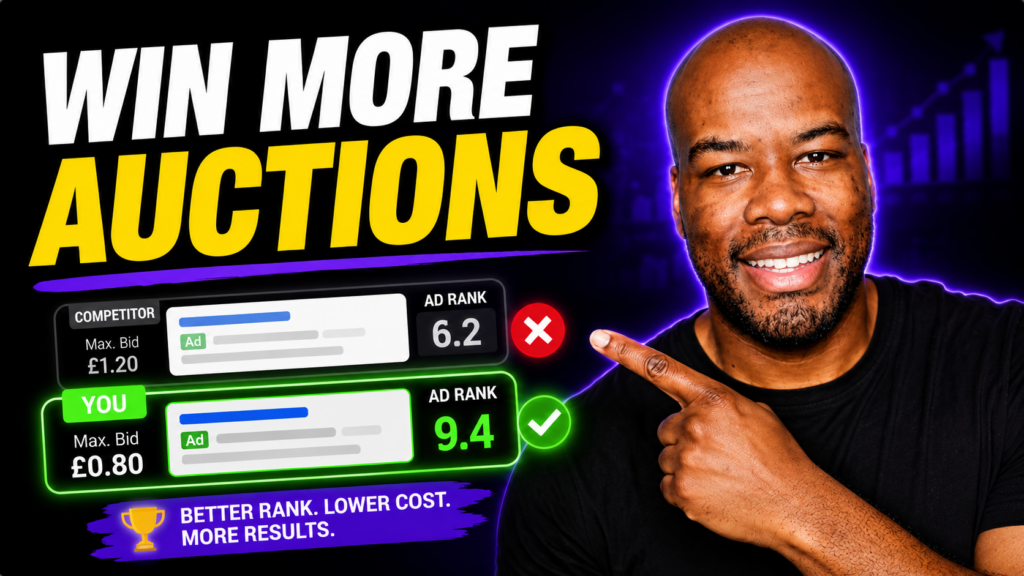
Ad rank determines whether your ads are competitive enough to appear in auctions.
Google evaluates several factors when calculating ad rank, including:
- Max CPC bids
- Ad quality
- Landing page relevance
- Competition levels
- Search context
- Ad assets and extensions
However, in practice, the biggest factor affecting impression share growth is usually:
Your CPC bid level
And this is where many advertisers make costly mistakes.
The Dangerous Side of Chasing Impression Share
To increase impression share significantly, advertisers often need to raise bids aggressively.
At first, increasing CPCs may generate noticeable gains in impression share.
But eventually, you reach a tipping point where:
- CPCs rise dramatically
- Impression share increases only slightly
This creates diminishing returns.
Why This Happens
Early increases in bids often produce meaningful visibility gains.
But once campaigns reach moderate impression share levels, further gains become increasingly expensive.
For example:
- Going from 10% to 30% impression share may be affordable
- Going from 60% to 80% may require doubling or tripling CPCs
Eventually, advertisers can end up paying huge amounts for marginal increases in visibility.
This is one of the biggest traps in Google Ads management.
Broad Match and Phrase Match Make Impression Share Misleading
Another major issue is that not all impressions are equally valuable.
This becomes especially important when using:
- Broad match keywords
- Phrase match keywords
- Smart bidding strategies
With broad or phrase match, Google can enter a much larger number of auctions.
That means:
- Available impressions increase massively
- Many impressions may have weak intent
- Higher impression share does not necessarily mean better traffic
In these situations, chasing impression share can actually encourage Google to pursue lower-quality clicks.
Why Smart Bidding Changes Everything
When using strategies such as:
- Target CPA
- Target ROAS
- Maximise Conversions
Google is already prioritising users most likely to convert.
This means Google may intentionally avoid certain auctions because they are unlikely to meet your efficiency targets.
So if you aggressively force impression share growth, you may accidentally undermine the very optimisation system that is improving your results.
The Metrics That Matter More Than Impression Share
Successful advertisers focus on business outcomes first.
That means prioritising metrics such as:
- Cost per acquisition (CPA)
- Return on ad spend (ROAS)
- Lead quality
- Revenue
- Profitability
- Conversion rate
Impression share should support these goals — not replace them.
How to Increase Impression Share the Right Way
Ironically, improving campaign performance often increases impression share naturally.
For example:
Better Conversion Rates
If your landing pages convert better:
- Google can bid more aggressively
- Your campaign becomes more competitive
- Impression share may rise automatically
Lower CPA
If your campaign starts generating cheaper conversions:
- Smart bidding gains more flexibility
- Auction competitiveness improves
- Visibility expands naturally
Better Lead Quality
If your business converts leads into customers more effectively:
- You can afford higher acquisition costs
- Budgets can scale profitably
- Impression share can grow sustainably
The Best Use Cases for Impression Share
Although impression share should not be your primary KPI, it is still extremely useful when interpreted correctly.
Monitoring Competitor Activity
If your impression share suddenly increases without changes to your campaigns, competitors may have:
- Reduced budgets
- Lowered bids
- Paused campaigns
- Exited the market
This can provide valuable competitive insights.
Understanding Seasonality
Impression share can also reveal seasonal demand fluctuations.
For example:
- During peak seasons, overall search volume may rise
- Your impression share may fall even if performance remains stable
- This happens because the total market size has expanded
Understanding this prevents advertisers from making unnecessary reactive changes.
The Real Purpose of Impression Share
Impression share is best viewed as a diagnostic metric — not a success metric.
It helps you understand:
- Market conditions
- Competitive pressure
- Scaling opportunities
- Auction behaviour
But it should never become the primary objective of your campaigns.
The ultimate goal is not to dominate impression share.
The real goal is to:
- Generate profitable leads
- Increase revenue
- Grow sustainably
- Maintain strong efficiency
If higher impression share supports those outcomes, great.
But if it damages profitability, it becomes counterproductive.
Final Thoughts
Most advertisers misunderstand impression share because they treat it as a direct measure of success.
In reality, it is only a secondary indicator.
A high impression share does not guarantee profitability.
And aggressively chasing it can lead to:
- Inflated CPCs
- Lower ROAS
- Poor-quality traffic
- Reduced efficiency
The smartest Google Ads advertisers focus on improving campaign fundamentals first:
- Better targeting
- Better conversion rates
- Better landing pages
- Better offers
- Better lead handling
When those improve, impression share often improves naturally as a by-product.
Focus on business growth first.
Treat impression share as supporting data — not the main objective.